A field guide to the soul of story
The Three Virtues in every great story.
Kirk is courage. Spock is truth. McCoy is love. The Scarecrow needs a brain. The Tin Man needs a heart. The Cowardly Lion needs courage. Luke Skywalker has love and courage — but not truth, and when the truth arrives, it breaks him. You already know this pattern. You've felt it in every story that ever moved you. This book finally names it.
Every story that has ever held you did it with the same three threads. Truth, Love, and Courage — what a character knows, what a character loves, and what a character is willing to risk. Take any hero apart and you'll find some arrangement of those three: one they have in abundance, one they lack, and one they must earn before the story can end. Take any villain apart and you'll find the same three, corrupted — truth turned to cruelty, love turned to possession, courage turned to wrath. This isn't a theory imposed on stories from the outside. It's the architecture that was always there. The Mythic Codex is the first book to draw the whole blueprint — and once you see it, you cannot unsee it.
A whole character can be drawn with three lines. The light of each virtue — and the dark it casts when it stands alone. This is the engine the rest of the book runs on.
The clear eye. The mind that refuses comfortable lies and sees the world as it actually is. Truth is what lets a hero name the danger, the enemy, and the cost before anyone else will.
The open heart. The willingness to be wounded for someone else's sake. Love is the reason the journey matters at all — the thing the hero is really fighting for, not just against.
The acting will. Not the absence of fear — the choice made against it. Courage is what carries truth and love off the page and into the deed, where they finally cost something.
The most famous arc in modern myth is a near-perfect demonstration. Luke begins with two virtues and is missing the third. The whole saga is the story of him earning it — and winning because he finally has it.
Luke leaves Tatooine with love for his friends and courage to spare. What he lacks is truth — about the galaxy, about the Force, about himself.
"I am your father." The one virtue he was missing is forced on him at the worst possible moment — and it does what unwanted truth always does. It breaks him.
He returns not to defeat his father but to redeem him — truth about who Vader is, love that refuses to give up on him, courage to walk in unarmed.
His victory isn't a duel won. It's a sword thrown away. He picks up the truth, refuses to fight, and the refusal is what saves them both.
The Codex walks the same three threads through the stories that built our imagination — across genre, century, and medium. A few of the constellations it maps:
Roddenberry split one whole person into three. Spock argues the truth, McCoy argues the love, and Kirk — standing between them — supplies the courage to decide. The show is the three virtues in conversation.
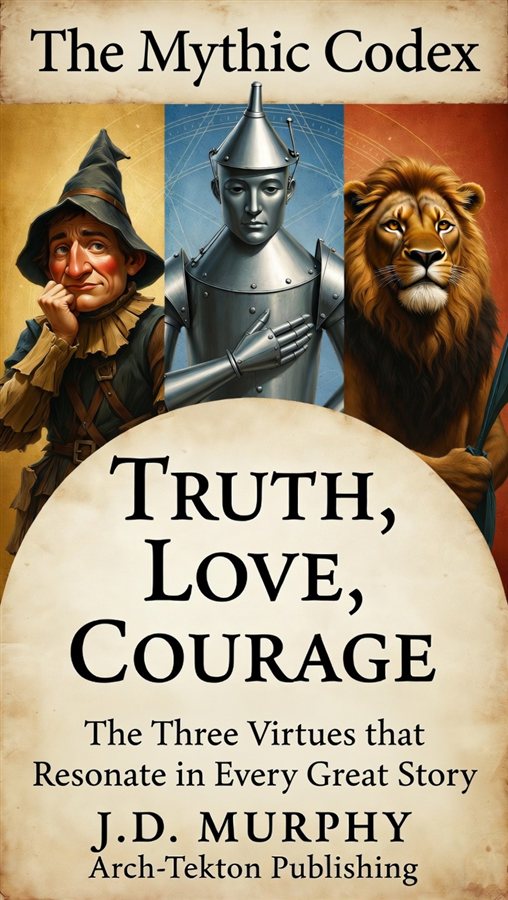
The Scarecrow wants a brain (truth), the Tin Man a heart (love), the Lion his nerve (courage). The joke — and the wisdom — is that each already has the very thing he's searching for. Dorothy carries all three home.
Luke's arc is the keystone case. The prequels run it in reverse — Anakin has truth and courage but his love curdles into possession, and the corruption of one virtue pulls down all three.
Gandalf is the truth that guides, Sam is the love that carries, Aragorn is the courage that leads. And the Ring is the perfect anti-virtue — a thing that corrupts all three at once, by turning every gift into greed.
From the Greek heroes to the prophets to the Gospels, the same three are tested and the same three shadows tempt. The Codex reads the ancient stories not as relics but as the original engineering drawings.
Games were the first to turn virtue into a mechanic you could fail. Ultima IV asked the player — not the character — to actually be truthful, loving, and brave. The Codex traces that lineage forward to the games we play now.
Storytellers have used the three virtues for as long as there have been stories, but almost always by instinct. One creator wrote them down as a system: Richard Garriott, who built Ultima IV: Quest of the Avatar around Truth, Love, and Courage and the eight virtues that flow from them.
It was a quiet revolution — a game that judged you not on how many monsters you killed but on whether you told the truth, showed compassion, and acted with courage. Forty years later, the idea is still waiting for someone to carry it all the way through the rest of our myths. That's the book.
If you've ever finished a story and felt it rearrange something in you — and wanted to understand the machinery under the magic — this was written for you. It's a craft book for makers and a decoder ring for everyone else.
You already know this pattern. You've felt it in every story that ever moved you. This book names it.✶ The promise of the Codex ✶
No spam. One email when The Mythic Codex launches — plus the occasional note when a chapter or a new constellation map goes live early.
We'll only email you about this book. Unsubscribe anytime.